
Standards for Explosion Protection
National laws (which are often based on EU directives) are legally binding:
■ They define safety objectives
■ They generally do not specify particular technical solutions
→ The application of European or national standards may be beneficial
Example: Development of Standards
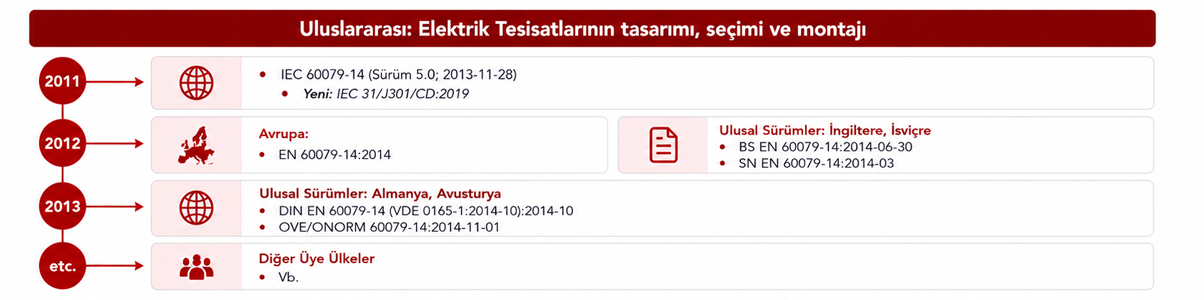
European Standards
| Manufacturer | User |
| EN 1127-1 (concepts and methodology) | EN 1127-1 (Concepts and Methodology) |
| EN 60079-0 (Equipment: General Requirements) | EN 60079-10-1 (zone classification—gas) |
| EN 60079-1 (flameproof enclosure "d") | EN 60079-10-2 (zone classification—dust) |
| EN 60079-7 (Increased Safety "e") | EN 60079-14 (Design, Selection, Installation) |
| EN 60079-11 (intrinsic safety "i") | EN 60079-17 (inspection) |
| EN 60079-15 (protection type "n") | EN 60079-19 (repair and maintenance) |
| EN 60079-18 (encapsulation "m") | EN 60079-29-2 (gas detectors) |
| EN 60079-28 (optical radiation "op") | EN 60079-30-2 (resistance-track heaters) |
| EN 60079-29-1 (gas detectors) | |
| EN 60079-30-1 (resistance-track heaters) | |
| EN 60079-31 (protection by enclosure "t") |
It is a long established fact that a reader will be distracted by the readable content of a page
when looking at its layout.
The point of using Lorem Ipsum is that it has a more-or-less normal distribution of letters, as
opposed to using 'Content here, content here', making it look like readable English. Many
desktop publishing packages and web page editors now use Lorem Ipsum as their default model text,
and a search for 'lorem ipsum' will uncover many web sites still in their infancy.
Various versions have evolved over the years, sometimes by accident, sometimes on purpose (injected
humour and the like).